ServicesWhole-Home Filtration
Whole-Home Filtration in Buda
Our whole-home systems go on the main supply line, so chlorine taste, odor and grit are taken out before water reaches any faucet, shower or appliance. We test your water first, size the tank to your plumbing and choose carbon media that matches the disinfectant your utility treats with.
What a whole-home system does, and what it doesn't
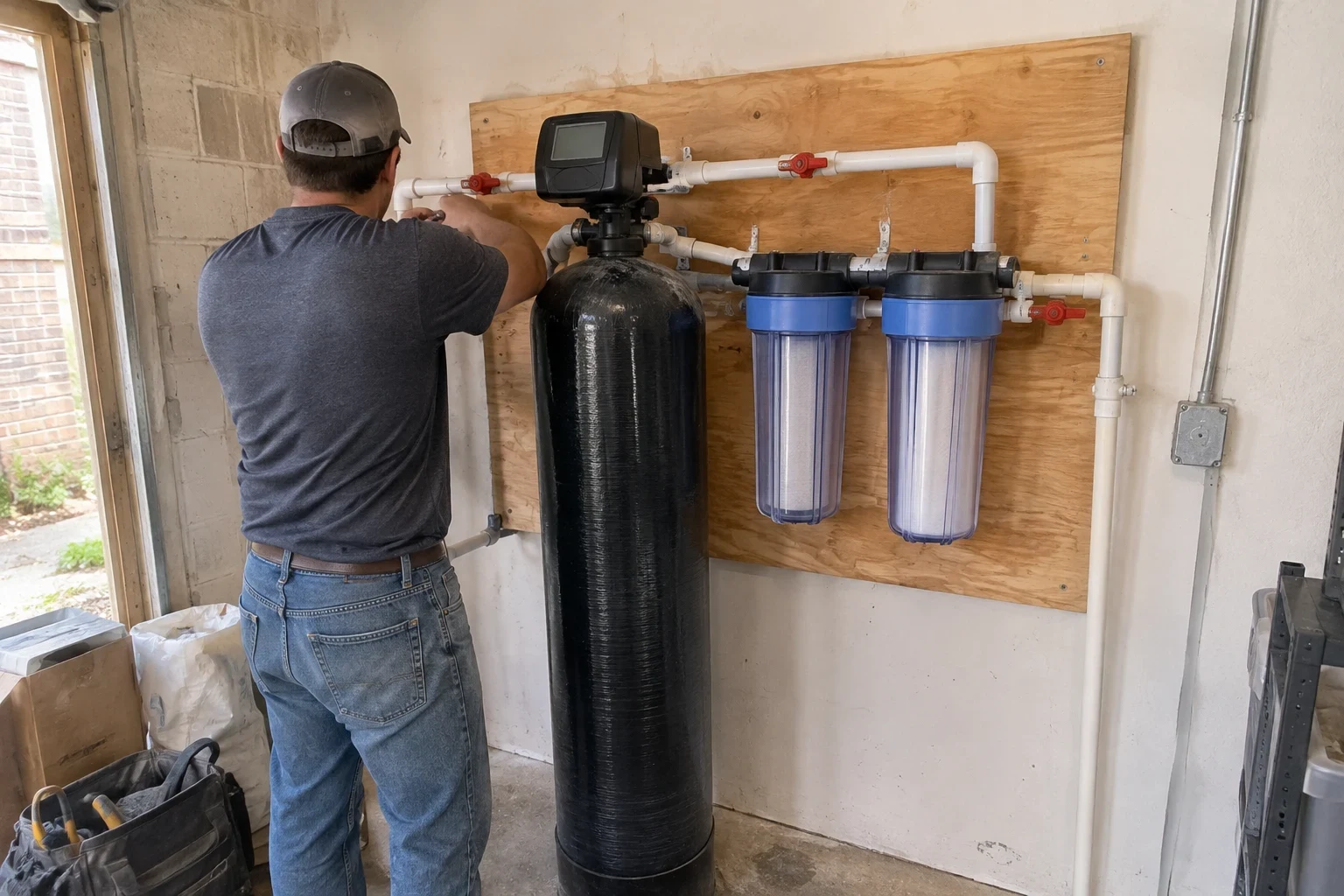
A whole-home filter, often called a point-of-entry system, is installed on the main line ahead of the water heater and before the plumbing splits off to the rest of the house. Most of the systems we put in use two stages. A sediment cartridge comes first and stops sand, pipe scale and other particles. Behind it, a tank of activated carbon adsorbs chlorine and chloramine, the disinfectants responsible for that swimming-pool smell, plus many compounds that make water taste off.
Carbon leaves hardness alone. Central Texas water dissolves calcium and magnesium from limestone, and the scale it leaves is its own issue. When your test shows high hardness, we tell you plainly and explain how a salt-free water conditioner or a water softener would work next to the filter, so you are not surprised by spotty glass and crusted fixtures after the install.
Filtration also touches your running costs. Grit that settles to the bottom of a tank water heater builds a layer between the burner or element and the water, and the heater burns more energy to bring the same tank up to temperature. Stopping sediment at the main line lets the heater run closer to how it was built to.
What's included in your installation
Water test before we quote
We measure chlorine, hardness, pH and iron so the equipment fits your water. If a result raises a bigger question, we will point you to lab work through our water testing and analysis service.
Sediment prefilter
A cartridge filter mounted upstream of the carbon tank catches sand and scale flakes first. The carbon bed lasts longer, and less debris ends up in your water heater and faucet aerators.
Catalytic or standard carbon tank
Standard granular activated carbon does a good job on free chlorine. Chloramine is more stubborn, so for chloraminated water we specify catalytic carbon, whose treated surface breaks it down much faster.
Bypass valve and shutoffs
Each system includes an integrated or three-valve bypass. You can keep water running to the house while a cartridge is swapped or the tank is serviced.
Grounding jumper where needed
Some electrical systems use the copper water line as their ground, and plastic filter fittings interrupt that path. In those homes we install a bonding jumper around the system so grounding stays intact.
Free installation
We offer free installation. Your quote is for the equipment, and we go over every line with you by phone before we order anything.
Signs your home could use whole-home filtration
Chlorine smell in the shower
Heat drives dissolved chlorine out of the water as vapor, and a closed bathroom holds that smell in more than any other room. Carbon on the main line treats the shower too, not only the kitchen faucet.
Dry skin or brittle hair after bathing
Plenty of people find their skin feels less tight once the shower water is chlorine-free. That comfort change is one of the main reasons families pick a whole-home system over a single tap filter.
Grit in aerators and showerheads
Sand or flakes collecting in aerator screens tell you sediment is traveling through your pipes. Some of that same material is piling up in your water heater.
Filters on every faucet
Buying pitcher cartridges and faucet-mount filters for several rooms adds up. A single point-of-entry system usually replaces them with less upkeep.
Water tastes flat or chemical
Disinfectant flavors are exactly what carbon is best at removing. If you want more from your drinking water, an under-sink reverse osmosis system is the right tool for that job.
How install day runs
- 1
Test and sizing
We tally your bathrooms and fixtures, work out peak demand in gallons per minute and review your test results. The tank is chosen so shower pressure stays steady even with the dishwasher going.
- 2
Locate and cut in
With the main shut off, we cut into the supply line at the point it enters the house, which is often in the garage. When it makes sense, we split off the irrigation line ahead of the filter so lawn watering doesn't wear out your carbon.
- 3
Assemble and bond
We hang the prefilter housing, level the carbon tank, plumb in the bypass and fit a grounding jumper if your electrical setup calls for one.
- 4
Flush and check
Fresh carbon sheds fine black dust at first, so we run the tank out to a drain until nothing cloudy comes through. After that we inspect every joint for leaks, compare pressure readings upstream and downstream, and clean the work area.
- 5
Walkthrough
We show you how to work the bypass, which cartridge gets changed and about how often, and what falling pressure is telling you.
What moves the price
Installation is free, so your price comes down mostly to equipment. The biggest drivers are how much water your home uses at once and what is in that water. We give you the quote by phone and explain each line.
- Tank size and flow rate
- A home with four bathrooms needs a larger carbon bed than a two-bath home to keep contact time up and pressure steady. Undersizing saves money upfront and costs you shower pressure every day.
- Type of carbon
- Catalytic carbon costs more than standard carbon but is the right media for chloramine. We match it to your water, not the other way around.
- Upflow vs. backwashing design
- Non-backwashing upflow tanks need no electricity and send no water to the drain. Backwashing heads use a timer and some water but can suit heavier sediment loads.
- Pairing with other treatment
- If the test shows hard water, adding a conditioner or softener changes the equipment list. We quote each piece separately so you can see what each one does.
Whole-home filtration questions
Something not covered here? (512) 975-3164
Will a whole-home filter soften my water?
No. Carbon pulls out chlorine, chloramine and many compounds behind bad taste and odor, but calcium and magnesium go right through it. If scale on fixtures or inside your water heater is what bothers you, we can talk through a salt-free conditioner or a water softener and how each would pair with the filter.
Will it lower my water pressure?
A correctly sized system takes a small, steady bite out of pressure that most families never notice. When pressure does drop, the usual cause is an undersized carbon bed or a sediment cartridge that stayed in well past its change interval. We size for your peak flow and take pressure readings on both sides of the system after it goes in.
How long does the carbon last before it needs replacing?
That comes down to how much water your household runs and how much chlorine is in it, but a carbon tank usually lasts several years. The sediment cartridge is the part you swap more often, typically once you notice pressure starting to fall. We lay out a realistic schedule based on your home.
Do I still need a reverse osmosis system for drinking water?
Not always. Whole-home carbon takes care of taste and odor at every tap. Reverse osmosis goes a step further for the water you drink and cook with, cutting dissolved solids and many trace contaminants, which is why some families add a unit under the kitchen sink.
Does it use electricity?
An upflow, non-backwashing tank draws no power at all. Backwashing models have a small control valve that plugs into a nearby outlet. We recommend whichever design suits your water and tell you why.
Start with a free water test
We will test your water, size a system to your home and give you a clear equipment quote, with installation free.